
2026 Programme
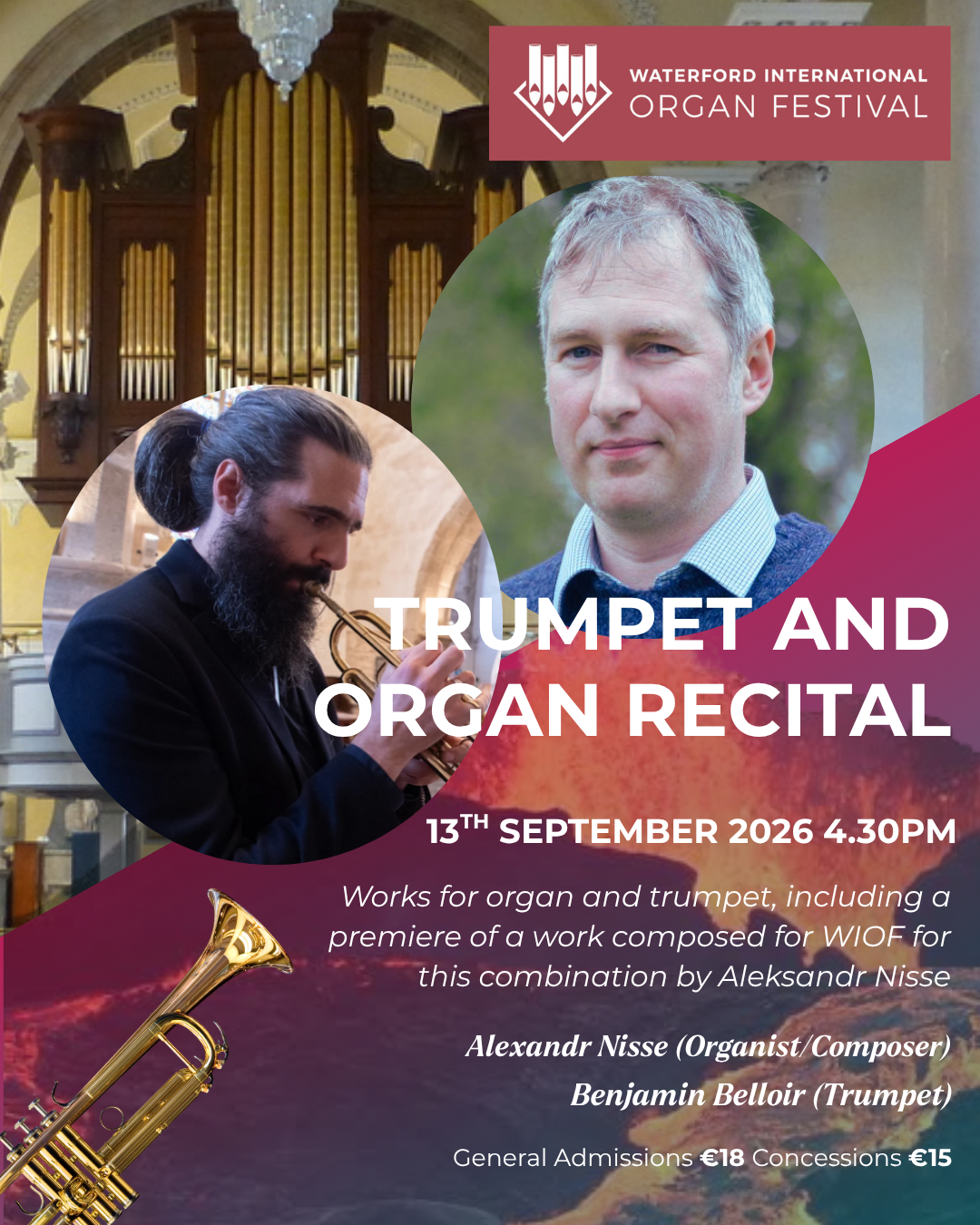
Trumpet and Organ Recital
Works for organ and brass and to include a premiere of a work composed for WIOF for this combination by Aleksandr Nisse
Organ: Aleksandr Nisse
Trumpet: Benjamin Belloir (France)
General Admissions: €18 Concessions: €15
Children under 18 accompanied by parents go free
Programme:
Charles Tournemire (1870–1939): Paraphrase – Carillon de la Messe de l’Assomption — 9 min
Danielle Salvignol (1944–1996): Six Pièces — 18 min
Irish Premiere of the complete set
Prière
Ave Maris Stella
Élégie
Fantaisie
Offertoire
Communion
Jean Langlais (1907–1991): Neuf Pièces pour trompette et orgue (1986) — 27 min
Aleksandr Nisse: Kínēsis (κίνηςις) — approx. 7 min
for trumpet and organ
World Premiere
About Alexandr Nisse’s Kínēsis (κίνηςις)
Commissioned by WIOF, is inspired by the geological formation of the Copper Coast in County Waterford, a UNESCO Global Geopark renowned for its dramatic coastline and remarkable geological history. The landscape preserves evidence of volcanic activity, ancient oceans, and tectonic movements spanning hundreds of millions of years. Rather than depicting the landscape itself, the work seeks to translate these immense geological processes into sound, compressing vast stretches of geological time into a musical experience.
The central idea of the composition is gradual transformation. Harmonic, rhythmic, spatial, and timbral processes unfold at different rates, creating a musical landscape in constant evolution. The work explores the tension between stability and imperceptible change, mirroring the slow accumulation of geological forces that ultimately shaped the Copper Coast.
The architecture of the church will become an integral part of the composition. Rather than remaining beside the organ throughout the performance, the trumpeter will move through different parts of the building, allowing the changing acoustics and physical space to shape the listener's experience. The movement of sound through the church reflects the evolving landscape and invites the audience to experience the music from continually shifting perspectives.
One movement is envisioned for two organs. Both instruments will perform the same musical material but at slightly different tempi. As the two parts gradually drift apart and reconnect, subtle harmonic changes emerge naturally from their interaction. These evolving sonorities are not the result of conventional harmonic progression but arise from the temporal displacement between the two organs. The process serves as a musical analogue to tectonic movement: almost imperceptible from moment to moment, yet capable of producing profound transformation over immense periods of time. The trumpet will weave freely above this continuously changing harmonic field, responding to the evolving texture. In this way, the gradual harmonic shifts become a compressed representation of the geological processes that formed the Copper Coast.
The mechanical nature of the organ also offers unique possibilities for subtle pitch transformation. By carefully manipulating the wind supply, delicate microtonal fluctuations can be produced, allowing the instrument to move beyond fixed tuning. The trumpet will mirror these fluctuations, creating a shared microtonal language between the two instruments. These slight instabilities in pitch become another reflection of geological processes—continuous, organic, and constantly evolving beneath the surface.
The organ will explore its complete registral spectrum, from its deepest foundations to its brightest upper voices. Together, the two instruments will traverse a vast sonic landscape whose breadth reflects the scale, diversity, and complexity of the Copper Coast itself.
The second movement will incorporate elements of controlled freedom. Rather than following a completely fixed score, the performers will be presented with a collection of notated musical fragments that may be selected freely while following a graphic score and a series of performance instructions. Coordination will be achieved through synchronised stopwatches, allowing the performers to maintain independent musical trajectories while remaining connected within a shared temporal framework. This balance between fixed structure and performer choice reflects the unpredictable yet ordered nature of geological evolution, where countless local events contribute to the formation of a coherent landscape over immense timescales.
The completed composition is expected to last approximately ten minutes and will consist of two movements. The world premiere of this work will be at WIOF 2026 on 13th September at 4:30pm.
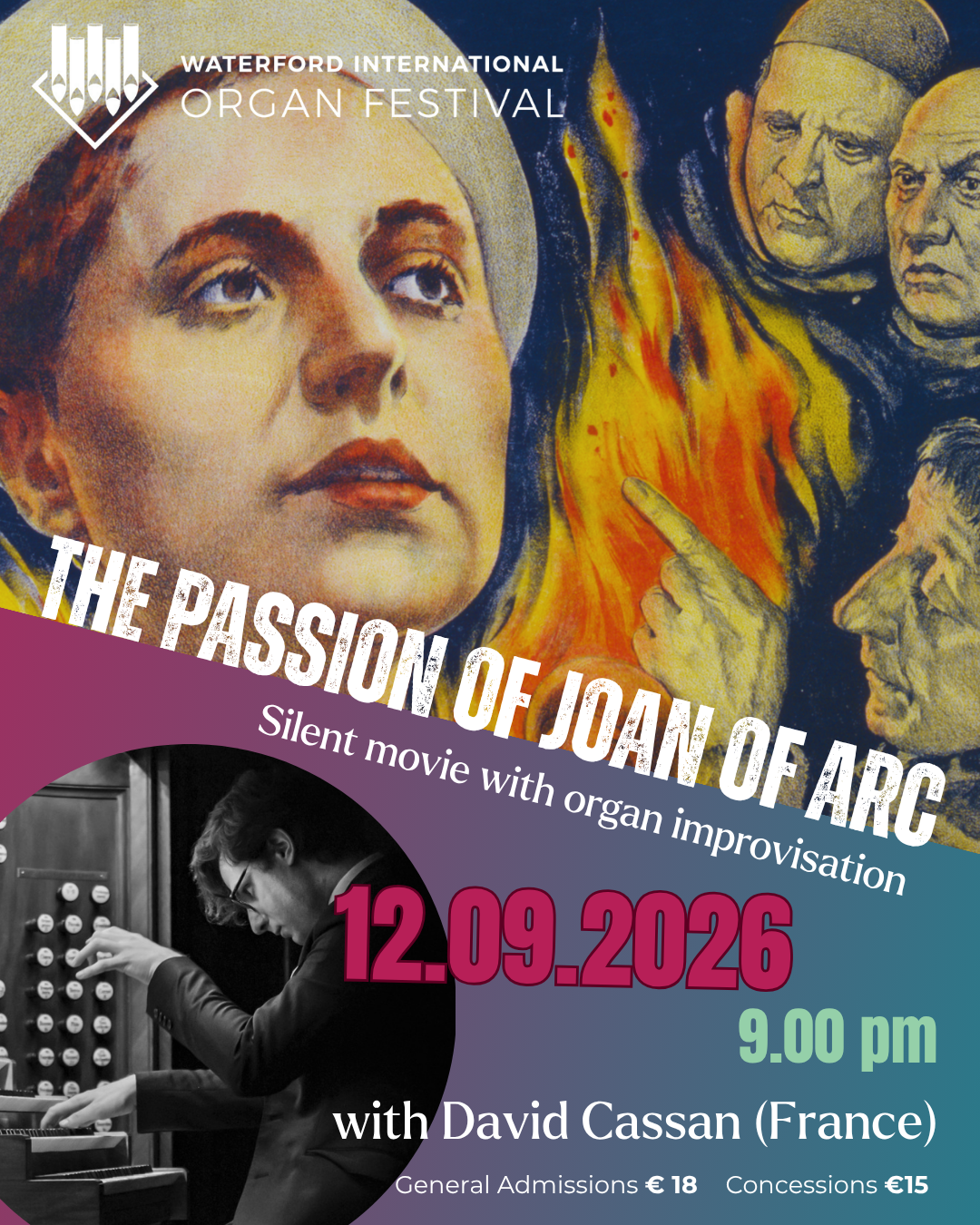
The Passion of Joan of Arc - Late night silent movie
Late night concert
Silent Movie: The Passion of Joan of Arc (1928, Dreyer)
Organ improvisation: David Cassan (Paris)
Entrance: €18 General Admissions, €15 Concessions
Children under 18 accompanied by parents go free
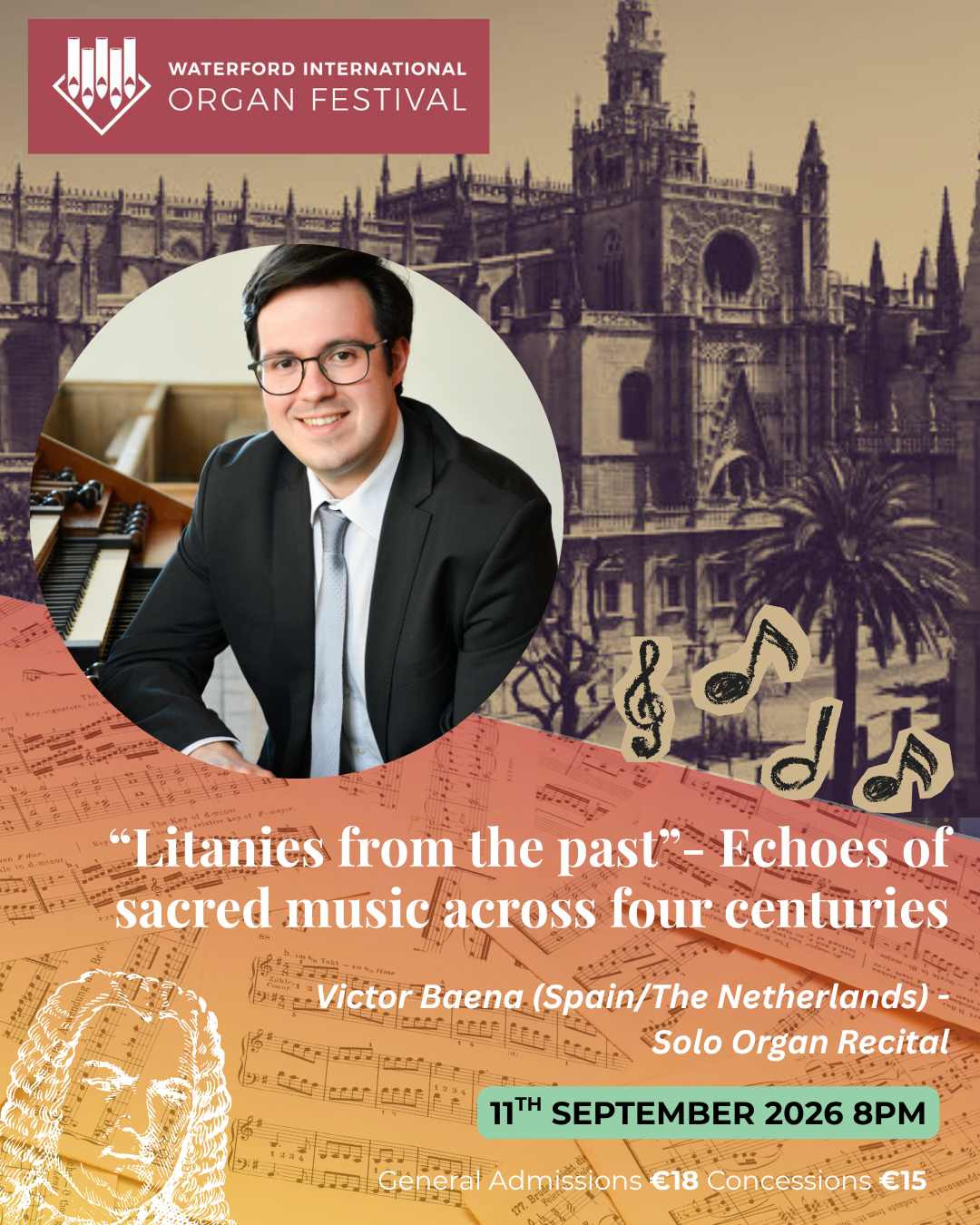
“Litanies from the past”- Echoes of sacred music across four centuries
Programme
Francisco Correa de Arauxo (1584-1654):
Tiento de sexto tono, sobre la Batalla de Morales FO 23 - Facultad Orgánica (Alcalá, 1626) – 400 years of its publication
J.P.Sweelinck (1562-1621)
Psalm 23 “Mein Hüter und mein Hirt” SwWV310
Eduardo Torres (1874-1934)
Saeta No.2
Jean Alain (1911-1940)
Variations sur “Lucis Creator” JA27
D.Buxtehude (1637-1707)
Toccata ex d BuxWV155
Johann Sebastian Bach (1685-1750)
Partite diverse sopra il Corale ‘Sei gegrüßet, Jesu gütig’, BWV768
(Choral and 11 variations)
Amy Summers (1996)
O lux Beata Trinitas
Jean Alain (1911-1940)
Litanies JA119
Entrance: €18 General Admissions , €15 Concessions
Children under 18 accompanied by parents go free
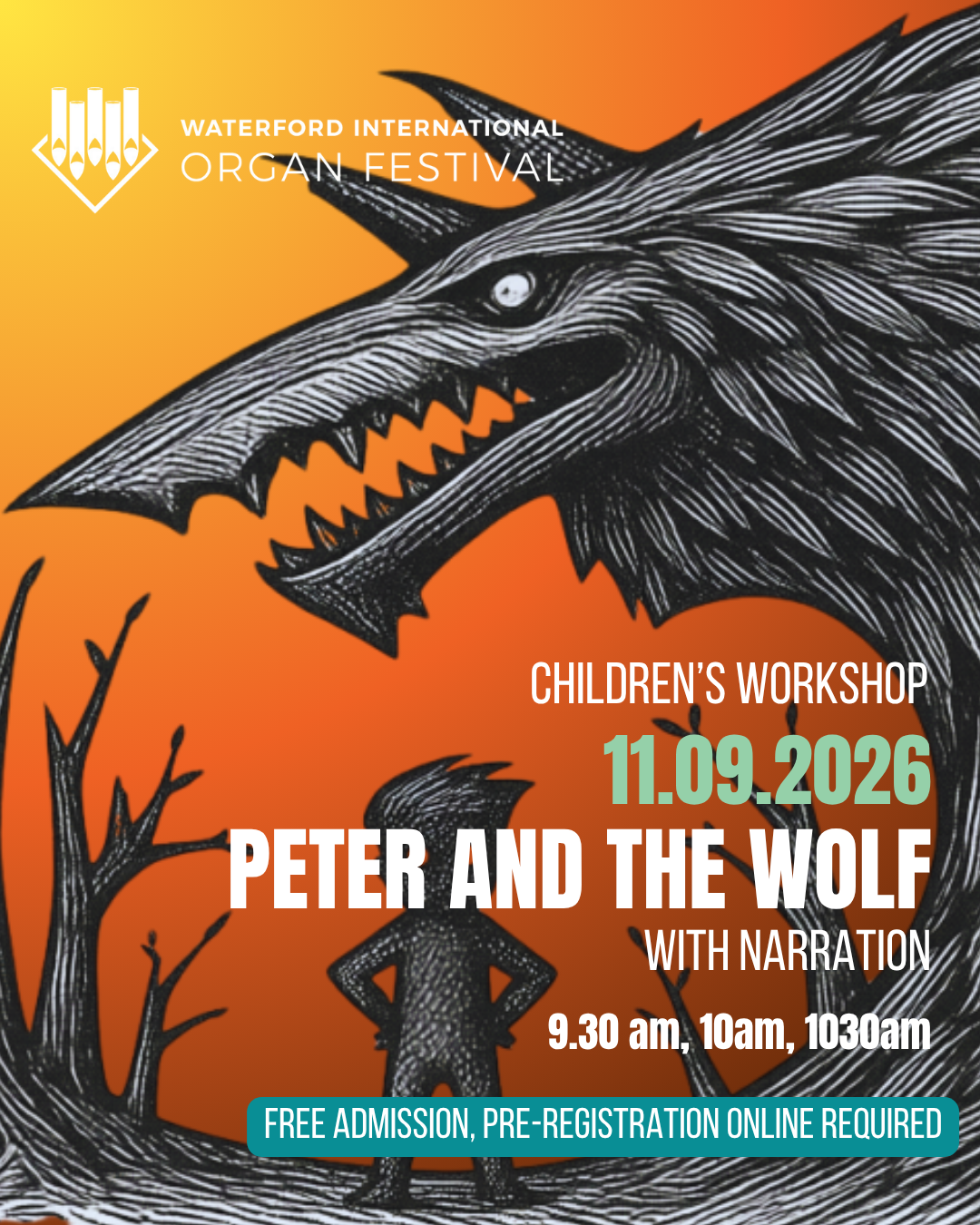
"Peter and the Wolf"- Children's Concert
Four children’s concerts with a narrated performance of Prokofiev’s “Peter and the Wolf”
Session 1- 9.30am, Session 2- 10.00 am, Session 3- 10.30 am
Organist: Simon Harden
Narration: Bruce Hayes
Entrance free, pre-registration required
Children must be accompanied by an adult.
Russian composer Sergei Prokofiev composed this programmatic piece based on the Russian folk tale “Peter and the Wolf”. It is originally written for an orchestra with the intent to introduce young children to individual instruments as the all the different character roles in this story were assigned to different instruments. An organ transcription of this piece will be played on the Elliot-Jones organ.
The pipe organ with its large library of sounds, has the unique ability to mimic the individual instruments used in this orchestral piece. During the workshop, narration of the story will be interspersed with organ playing, accompanied by images to depict the storyline. This is a fun, immersive listening experience and an excellent opportunity to introduce young children to the pipe organ!
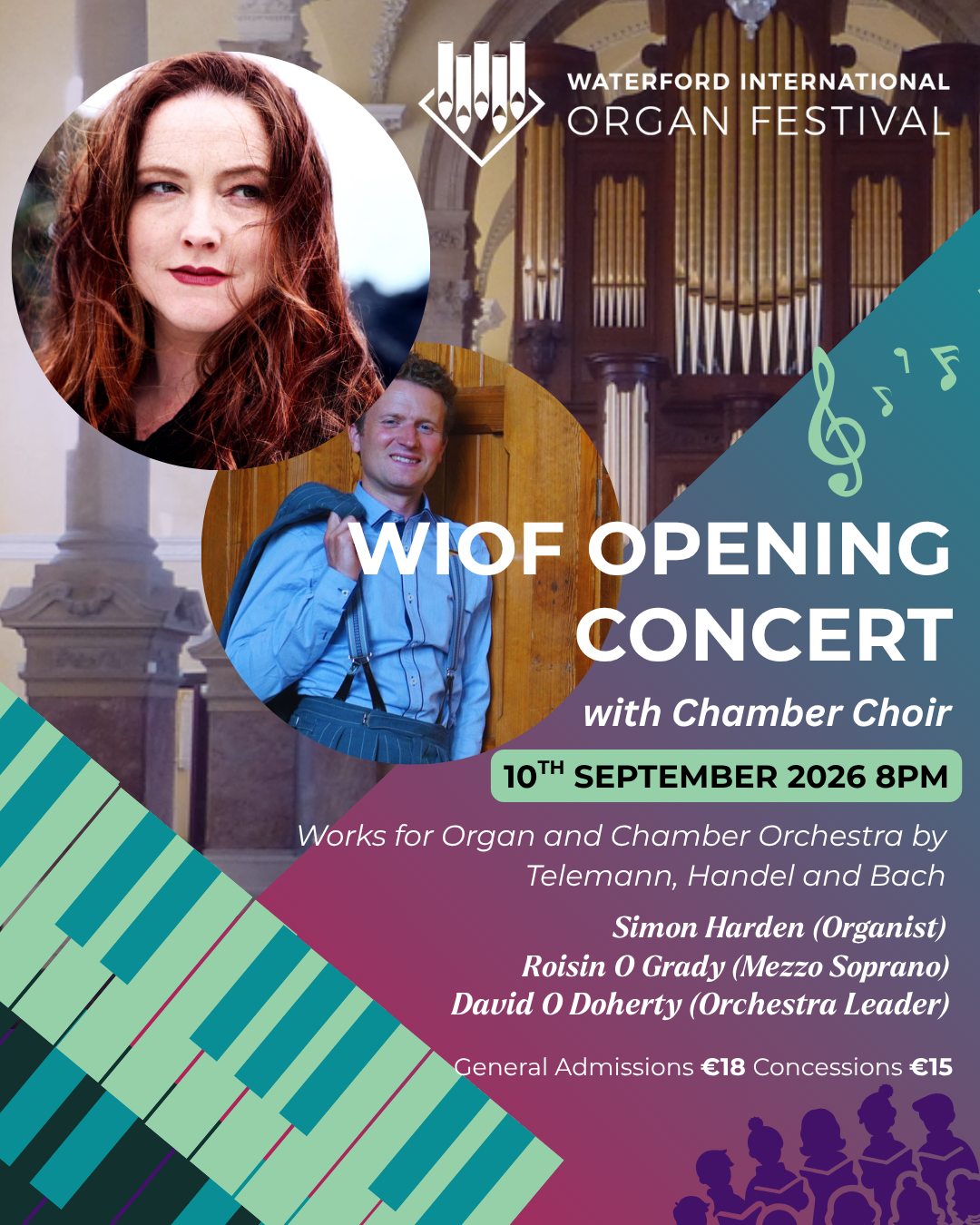
Opening Concert with WIOF Chamber Choir
Programme
Telemann: Ein feste Burg ist unser Gott TWV 8:7 (11’)
Telemann: Liebe, die von Himmel stammt TWV 1:1044 (9’)
Handel: Organ Concerto in B flat major op.4 no.2, HWV290 (11’)
JS Bach Vergnügte Ruh’, beliebte Seelenlust BWV 170 (23’)
Lobet den Herrn, all Heiden BWV 230
Organist: Simon Harden
Mezzo-soprano: Rosin O’Grady
WIOF chamber orchestra. Leader David O’Doherty
General Admissions: €18 Concessions: €15
Children under 18 accompanied by parents go free
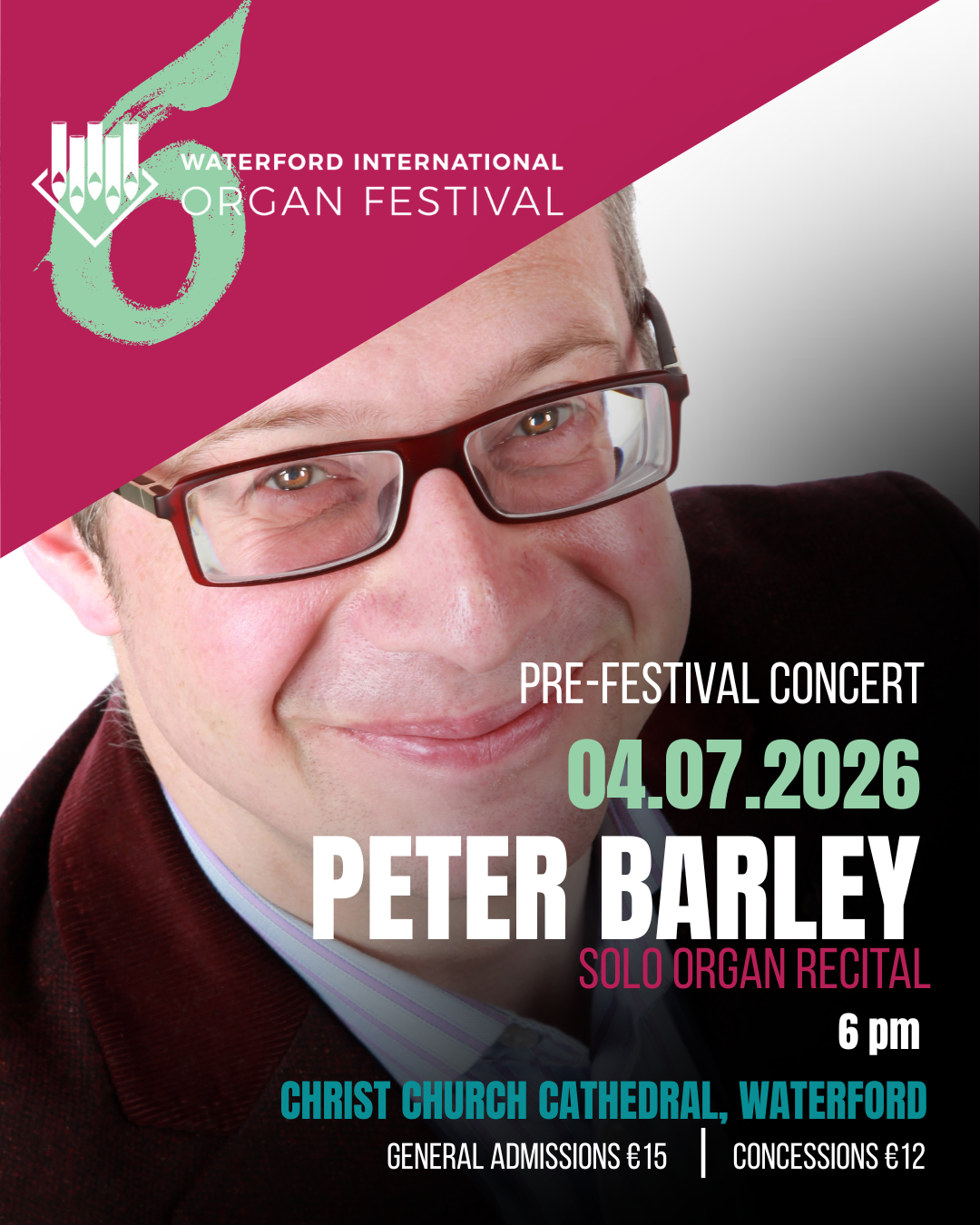
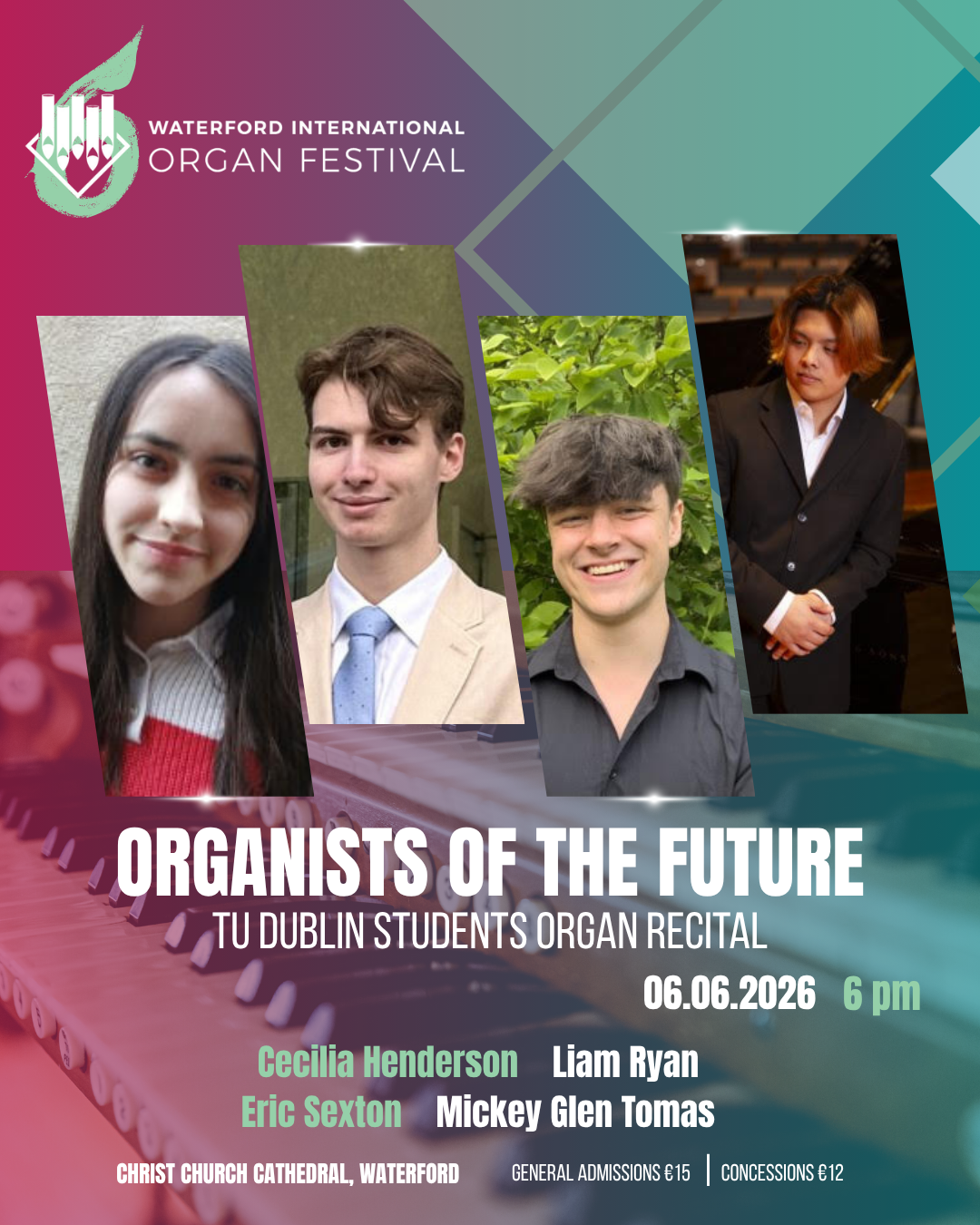
Organists of the Future
Students of TU Dublin Conservatoire:
Cecilia Henderson
Liam Ryan
Eric Sexton
Mickey Glen Tomas
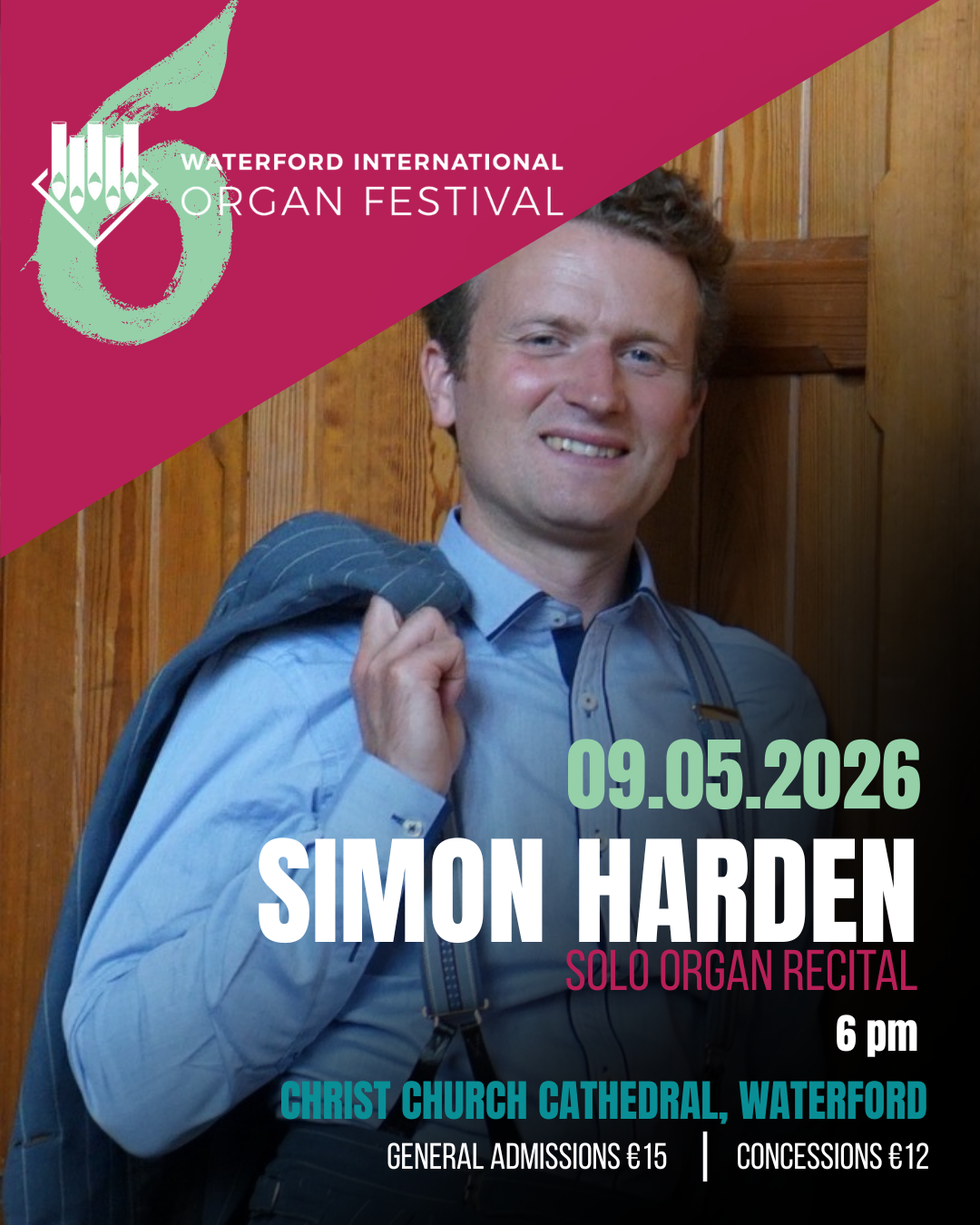
“Mon orgue, c’est mon orchestre”
Programme
Maurice Duruflé (1902-1986) Prélude de la Suite Op. 5 (9’)
Nicolas de Grigny (1671-1703) From: Messe Cunctipotens genitor Deus (7’)
1 er Kyrie en taille à 5
Cromorne en taille à 2 parties
Dialogue sur les grands jeux
Charles Marie Widor (1844-1937) From: Symphony VI in G minor Op. 42, No. 2 (1880)
-Intermezzo (6’ 00”)
César Franck (1822-1890) Troisième Choral en la mineur (12’ 00’’)
Jehan Alain (1911-1940) Le jardin suspendu (chaconne) (7’)
Louis Vierne (1870-1937) Carillon de Westminster (7’)